
Taste of Toraja Coffee: A Flavor from the Highlands
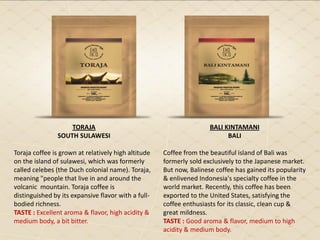
Perched high amidst the dramatic peaks and lush valleys of South Sulawesi, Indonesia, lies the mystical land of Tana Toraja. It’s a region renowned not only for its unique cultural heritage – the distinctive boat-shaped Tongkonan houses and elaborate funeral ceremonies – but also for something equally profound and deeply rooted in its soil: Toraja coffee. More than just a beverage, a cup of Toraja coffee is an invitation to explore a complex landscape, a rich history, and the dedicated craftsmanship of its people. For those seeking an extraordinary coffee experience, Toraja offers a flavor profile as captivating and memorable as the highlands from which it originates.
The Land of Origin: Where Earth Meets Sky
The story of Toraja coffee begins with its extraordinary geography. Tana Toraja, meaning "the land of the Toraja people," is characterized by its high altitudes, typically ranging from 1,000 to 1,700 meters above sea level. This elevation is critical for cultivating high-quality Arabica coffee beans, which thrive in cooler temperatures and distinct day-night cycles. The region’s volcanic soil, enriched by millennia of geological activity, provides a nutrient-dense foundation, while ample rainfall and natural shade from towering indigenous trees create an ideal microclimate.
Imagine misty mornings giving way to bright, sun-drenched days, with the rich aroma of earth and blossoming coffee trees carried on the cool mountain air. This pristine environment, largely untouched by industrialization, is the cradle of Toraja coffee, contributing significantly to its distinct character. The coffee plants here are often shade-grown, a traditional and sustainable practice that not only protects the delicate beans from harsh sunlight but also supports biodiversity, providing habitat for local flora and fauna.
A Rich History Brewed Over Centuries
Coffee cultivation in Indonesia dates back to the late 17th century, introduced by Dutch colonialists. While initial efforts focused on Java, the plant soon found its way to other islands, including Sulawesi. The Torajan people, known for their deep connection to the land and their agricultural prowess, quickly embraced coffee farming. For generations, coffee has been more than just a crop; it’s been a way of life, an economic backbone, and an integral part of their cultural identity.
Toraja coffee is almost exclusively of the Arabica variety, specifically the Typica and S-795 cultivars, among others. These traditional varieties, passed down through generations, are prized for their potential to develop nuanced and complex flavors. Unlike large-scale plantations, Toraja coffee is predominantly grown by smallholder farmers, often on plots no larger than a few acres. These families meticulously tend to their coffee trees, hand-picking only the ripest, reddest cherries, ensuring a higher quality yield. This hands-on approach, from planting to harvest, embodies a deep respect for the land and the product.
The Art of Processing: Giling Basah’s Signature
One of the most defining characteristics of Toraja coffee, and indeed many Indonesian specialty coffees, is the unique processing method known as "Giling Basah," or wet-hulled. This method sets it apart from the fully washed or natural (dry-processed) coffees found in other parts of the world and is a significant contributor to its distinctive taste profile.
Here’s a simplified breakdown of the Giling Basah process:
- Cherry Picking: Ripe coffee cherries are hand-picked.
- Pulping: The outer skin and some fruit pulp are removed, usually within hours of harvesting, using simple pulping machines.
- Fermentation (brief): The beans, still encased in their mucilage (a sticky layer), are often left to ferment briefly, typically overnight, to break down the mucilage.
- Initial Washing: The beans are washed to remove the remaining mucilage.
- Partial Drying (Parchment Coffee): At this stage, the beans are still covered by a protective parchment layer. They are dried for a short period, bringing their moisture content down to about 30-35%.
- Wet Hulling: This is the critical step. Unlike fully washed coffees that are dried to a much lower moisture content (10-12%) before hulling, Giling Basah coffee is hulled while it is still significantly wet. This removes the parchment layer.
- Final Drying: The now exposed, greenish-blue beans are spread out to dry further, often on patios or tarpaulins, until they reach the ideal moisture content for export.
This accelerated, high-moisture hulling process, often conducted by local collectors or cooperatives, is believed to impart specific qualities to the bean. It reduces acidity, enhances the coffee’s body, and contributes to the earthy, sometimes savory or spicy notes that are hallmarks of Toraja coffee. The beans themselves often take on a unique, dark greenish hue due to this method.
Unveiling the Taste Profile: A Symphony of Flavors
The culmination of Toraja’s unique terroir, traditional Arabica varieties, and the Giling Basah processing method results in a truly captivating cup. Toraja coffee is celebrated for its full-bodied richness and low acidity, making it incredibly smooth and approachable.
Upon first sip, you’re likely to encounter a complex tapestry of flavors:
- Earthiness: A foundational, deep earthiness is often present, reminiscent of damp soil, aged wood, or even a hint of forest floor. This is a signature of the Giling Basah process.
- Chocolate Notes: Dark chocolate or cocoa undertones are common, adding a pleasant bitterness and depth.
- Spices: Subtle hints of warm spices like nutmeg, clove, or cinnamon can emerge, providing a comforting and exotic warmth.
- Fruity Nuances: While not overtly fruity, some Toraja coffees exhibit delicate notes of ripe berries, stone fruit, or a gentle citrus zest, adding brightness to the darker profile.
- Nutty Undertones: Roasted nut flavors, such as almond or walnut, can sometimes be detected, contributing to its satisfying finish.
- Caramel/Sweetness: A mild, underlying sweetness, akin to caramel or brown sugar, often balances the earthier and spicier elements.
Compared to other Indonesian heavyweights like Sumatra Mandheling, Toraja coffee often presents a slightly cleaner, brighter cup, though still maintaining the signature Indonesian body and low acidity. It’s a coffee that rewards slow sipping, allowing its layers of flavor to unfold and tell their story.
Beyond the Bean: Culture, Sustainability, and Community
Toraja coffee is more than just an agricultural product; it’s a vital part of the region’s socio-economic fabric. Coffee farming provides livelihoods for thousands of families, allowing them to preserve their unique cultural traditions. Many farmers practice sustainable methods, relying on organic fertilizers, natural pest control, and shade-grown cultivation. Efforts are also underway to promote fair trade practices, ensuring that farmers receive equitable compensation for their hard work and high-quality beans.
When you choose Toraja coffee, you’re not just buying a bag of beans; you’re supporting a community, preserving an ancient culture, and contributing to sustainable agricultural practices that respect both the land and its people.
Brewing the Perfect Cup: Experience the Highlands
To truly appreciate the "Taste of Toraja," consider these brewing suggestions:
- Freshness is Key: Always use freshly roasted and freshly ground beans. Grind just before brewing for optimal flavor.
- Brewing Methods: Toraja coffee shines in methods that allow its body and complex flavors to develop.
- French Press: Ideal for maximizing its full body and earthy notes.
- Pour-Over (e.g., V60, Chemex): Can highlight its nuanced sweetness and subtle fruitiness, offering a cleaner cup.
- Espresso: Produces a rich, crema-laden shot with intense chocolate and earthy notes.
- Water Temperature: Use water just off the boil, around 90-96°C (195-205°F).
- Ratio: A good starting point is a 1:15 or 1:16 coffee-to-water ratio (e.g., 20g coffee to 300ml water).
A Journey in Every Sip
Toraja coffee is an experience, a journey from the misty highlands of Sulawesi directly to your cup. It’s a testament to the power of unique geography, traditional farming methods, and a distinct processing technique to create something truly exceptional. Each sip offers a glimpse into the heart of Tana Toraja, a land where culture, nature, and craftsmanship intertwine to produce a flavor that is at once exotic, comforting, and utterly unforgettable. So, the next time you seek a coffee that tells a story, reach for Toraja – a flavor from the highlands, waiting to be discovered.