

Exploring Borobudur Temple: A Journey Through the World’s Largest Buddhist Monument
Nestled amidst the lush, volcanic landscapes of Central Java, Indonesia, an ancient marvel rises from the earth, beckoning travelers and spiritual seekers alike. Borobudur Temple, a UNESCO World Heritage site, is not merely a structure of stone; it is a monumental testament to human ingenuity, artistic mastery, and profound spiritual devotion. As the world’s largest Buddhist monument, Borobudur offers an unparalleled journey – an ascent from the material world to the realm of enlightenment, carved meticulously into its very architecture.
For anyone seeking a travel experience that transcends the ordinary, Borobudur is a destination that promises awe, introspection, and a deep connection to an ancient past. Let’s embark on an exploration of this colossal masterpiece, understanding its history, deciphering its intricate symbolism, and discovering what makes it a truly unique wonder of the world.
The Enigma Emerges: History and Rediscovery
The story of Borobudur is as captivating as its physical presence. Built during the 8th and 9th centuries by the Sailendra Dynasty, a powerful Buddhist kingdom that ruled Java, Borobudur’s construction was a staggering undertaking. For an estimated 75 to 100 years, thousands of skilled artisans, sculptors, and laborers meticulously crafted this massive edifice using volcanic andesite stone, without the aid of mortar. Its purpose was clear: to serve as a grand Mahayana Buddhist temple and a site for pilgrimage and spiritual instruction, symbolizing the path to Nirvana.
However, around the 10th century, Borobudur’s glory began to wane. The reasons are still debated by historians, but a combination of factors likely contributed to its abandonment: the decline of the Mataram Kingdom, the shift of power to East Java, and perhaps most significantly, the gradual conversion of the Javanese population to Islam, which became the dominant religion. Over centuries, Borobudur was swallowed by the dense tropical jungle, buried under layers of volcanic ash from nearby Mount Merapi, and largely forgotten by the outside world, becoming a local legend.
It wasn’t until 1814 that the world began to rediscover Borobudur, thanks to Sir Thomas Stamford Raffles, the British Lieutenant-Governor of Java. Intrigued by local tales of a massive monument hidden in the forest, Raffles commissioned a Dutch engineer, H.C. Cornelius, to investigate. What Cornelius and his 200 men uncovered over several months was nothing short of astonishing: a colossal temple, largely intact but crumbling, its beauty obscured by vegetation and debris.
The subsequent century saw various attempts at restoration, but it was the monumental effort led by UNESCO from 1973 to 1983 that truly saved Borobudur from ruin. This ambitious project involved dismantling and rebuilding the entire structure, piece by piece, to stabilize its foundations and restore its intricate carvings, ensuring that future generations could witness its splendor.
An Architectural Marvel: A Cosmic Mandala in Stone
Borobudur is more than just a temple; it’s a three-dimensional representation of the Buddhist cosmos, a spiritual textbook carved in stone. Its design is a gigantic stupa, built on a natural hill, and structured as a stepped pyramid with nine platforms: six square platforms at the base, topped by three circular platforms, and crowned by a central dome.
The entire structure guides pilgrims through a symbolic journey from the earthly realm of desire to the highest state of spiritual purity. This journey is divided into three main levels, representing the three realms of Buddhist cosmology:
- Kamadhatu (The World of Desire): This lowest level, originally hidden beneath a later extension to prevent subsidence, depicts human beings trapped by desire and negative impulses. While largely concealed, some sections of the "hidden foot" have been uncovered, revealing intricate reliefs illustrating the law of karma.
- Rupadhatu (The World of Forms): Comprising the five square terraces, this level represents the realm where individuals have overcome desire but are still bound by form and individuality. This is where Borobudur truly comes alive with its most celebrated features: over 2,672 relief panels stretching for more than 3 kilometers, and 504 Buddha statues. The reliefs narrate the life of Buddha (Lalitavistara), the Jataka tales (stories of Buddha’s previous lives), and the Gandavyuha (the spiritual journey of Sudhana). Walking clockwise along these galleries is a meditative experience, a literal reading of Buddhist philosophy and morality. Each relief is a chapter, guiding the pilgrim towards wisdom.
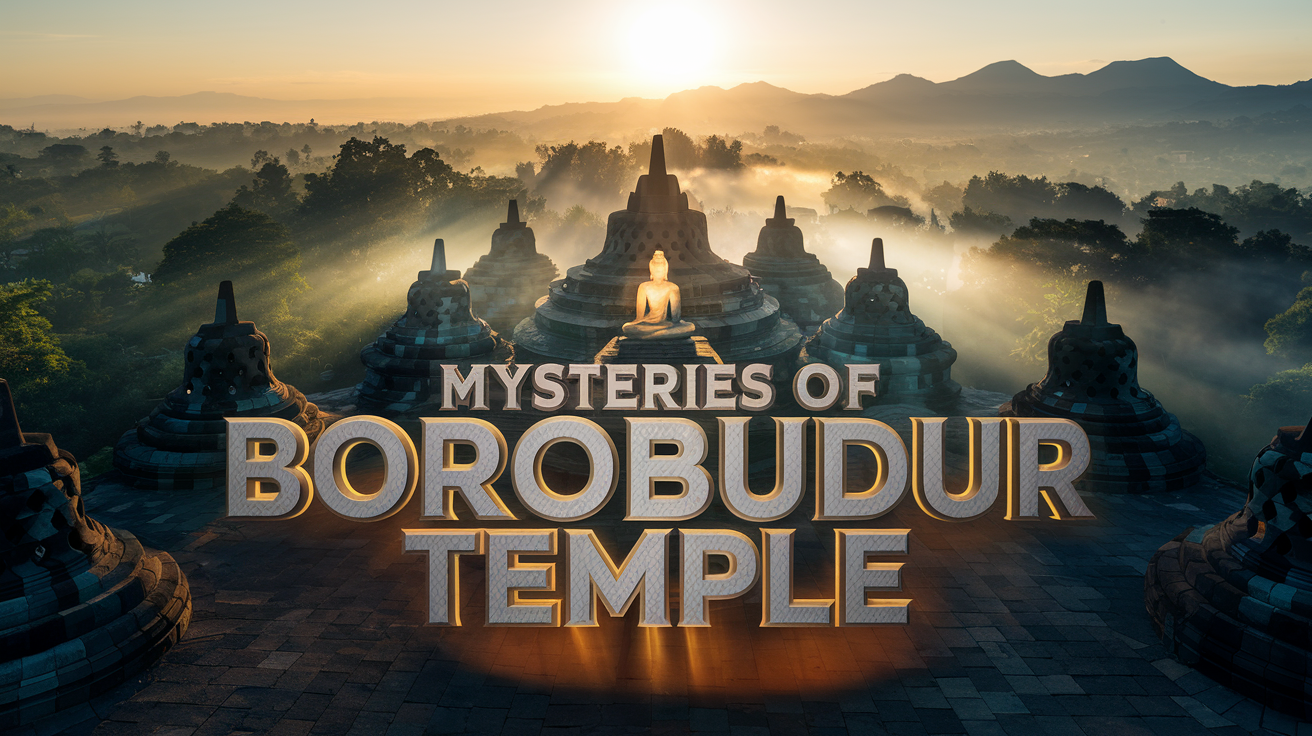
- Arupadhatu (The World of Formlessness): The three uppermost circular terraces represent the realm of pure spirit, where one has transcended all worldly attachments, including form. These terraces are starker, devoid of relief carvings, and feature 72 bell-shaped perforated stupas, each containing a statue of a meditating Buddha. The sight of these Buddhas, partially visible through the lattice of the stupas, creates an ethereal sense of peace and mystery. The journey culminates at the massive central stupa, which is empty, symbolizing ultimate enlightenment (Nirvana) – the void, the ultimate release from the cycle of rebirth.
The sheer scale and detail are breathtaking. Each Buddha statue exhibits a different mudra (hand gesture), signifying various teachings and moments in Buddha’s life, subtly changing as one ascends, reflecting the progressive stages of enlightenment.
The Journey of Exploration: Ascending Towards Enlightenment
To truly explore Borobudur is to participate in its intended spiritual pilgrimage. The experience begins at the eastern entrance, following the ancient ritual of pradakshina (circumambulation) by walking clockwise around each terrace. As you ascend, the world below gradually recedes, replaced by panoramic views of lush fields, distant volcanoes, and the intricate details of the temple itself.
The early morning, particularly at sunrise, is a magical time to visit. As the first rays of light paint the sky in hues of orange and purple, they illuminate the ancient stones, casting long shadows and creating an almost mystical atmosphere. The mist often hangs low, giving the impression that the temple is floating above the clouds. This is when the silence of the monument truly speaks, inviting contemplation.
As you navigate the galleries, take your time to examine the reliefs. While understanding every narrative might require a guide, simply appreciating the artistry, the flow of the stories, and the expressions on the carved figures offers profound insight into ancient Javanese culture and Buddhist teachings. Each step upward is a metaphor for spiritual progress, moving from the earthly struggles depicted at the base to the serene emptiness at the apex.
Reaching the circular terraces, the open sky and the unique bell-shaped stupas create a powerful sense of arrival. The Buddhas within, glimpsed through the stone lattices, seem to gaze out at the vast expanse, embodying tranquility. The final ascent to the central stupa provides a sense of culmination, a moment of profound quiet reflection amidst the grandeur. From here, the world unfolds below, a vast tapestry of green, offering a perspective that feels both expansive and deeply personal.
Beyond the Stone: Borobudur’s Enduring Spirit
Today, Borobudur is not only a world-renowned tourist destination but also a vibrant pilgrimage site, especially for Indonesian Buddhists who celebrate Vesak Day (Buddha’s birthday) with grand ceremonies at the temple. It stands as a powerful symbol of Indonesia’s rich cultural and religious diversity and a testament to the enduring power of faith and art.
Yet, its future also presents challenges. The immense popularity brings issues of preservation, managing mass tourism, and protecting the delicate ecosystem around it. The constant battle against erosion, volcanic ash, and human impact requires ongoing dedication and resources.
Exploring Borobudur Temple is more than just sightseeing; it’s an immersive historical, artistic, and spiritual journey. It’s an opportunity to connect with an ancient civilization’s profound wisdom, to witness an architectural marvel that has stood for over a millennium, and to embark on your own symbolic ascent towards understanding and peace. Whether you are a historian, an artist, a spiritual seeker, or simply a curious traveler, Borobudur will leave an indelible mark on your soul, reminding you of the boundless possibilities of human endeavor and the timeless quest for enlightenment.