

Komodo National Park: Home of the Last Dragons – A Journey into the Wild Heart of Indonesia
Imagine stepping back in time, to an era when colossal reptiles roamed the Earth, ruling their domain with ancient power and primeval grace. While the dinosaurs are long gone, their legacy lives on in a remote corner of Indonesia, where the world’s largest living lizard, the Komodo dragon, reigns supreme. Welcome to Komodo National Park, a UNESCO World Heritage Site and a Man and Biosphere Reserve, an extraordinary destination that promises an adventure unlike any other. This is not just a park; it’s a vibrant ecosystem where nature’s raw beauty converges with unparalleled biodiversity, offering a profound journey into the wild heart of our planet.
The Majestic Komodo Dragon: Earth’s Living Relic
At the very core of Komodo National Park’s allure is its iconic inhabitant: the Komodo dragon (Varanus komodoensis). These magnificent creatures are truly a sight to behold, embodying the power and mystery of a bygone era. Growing up to an astonishing 10 feet (3 meters) in length and weighing over 300 pounds (136 kg), they are formidable predators, covered in rough, scaled skin that provides a natural armor. Their powerful limbs, sharp claws, and serrated teeth are perfectly adapted for their role as the apex predator of their island homes.
Komodo dragons are ambush hunters, patiently waiting for prey to wander by before launching a lightning-fast attack. Their bite is incredibly potent, capable of delivering not only a devastating physical wound but also a cocktail of venomous proteins that prevent blood clotting and induce shock, quickly incapacitating their victims. Contrary to popular belief, while their mouths do harbor a diverse array of bacteria, recent research suggests that venom plays a more significant role in their hunting strategy than previously thought. They feast on everything from deer and wild boar to water buffalo and even smaller dragons, showcasing their opportunistic and voracious appetite.
Remarkably, Komodo dragons also exhibit a rare form of asexual reproduction called parthenogenesis, where a female can lay fertile eggs without mating with a male. This incredible adaptation ensures the survival of the species even in isolated conditions. However, despite their ancient lineage and formidable nature, Komodo dragons are classified as "Endangered" by the IUCN, making Komodo National Park a critical sanctuary for their survival.
Beyond the Dragons: The Archipelago’s Breathtaking Beauty
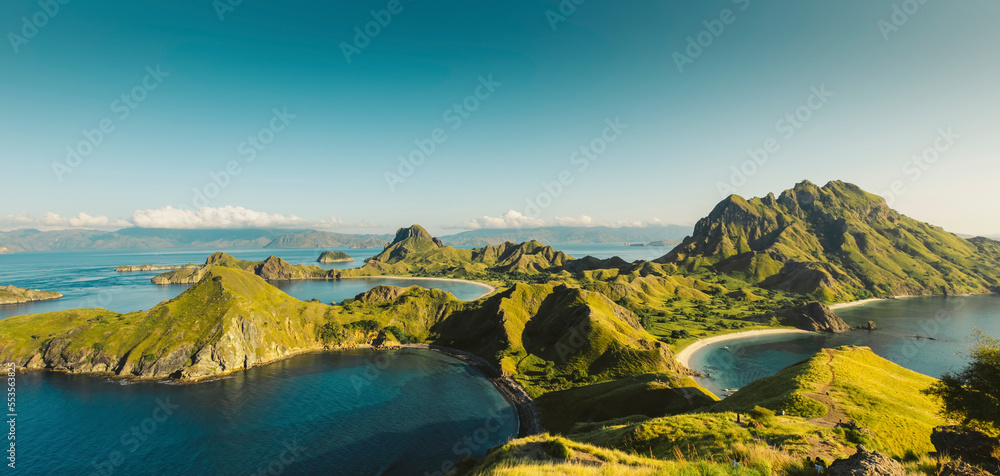
While the Komodo dragon is undoubtedly the star attraction, the national park offers far more than just encounters with these magnificent reptiles. Spanning over 1,733 square kilometers, including land and marine areas, the park encompasses a breathtaking archipelago of volcanic islands, rugged hills, dry savannahs, and pristine beaches. The three main islands – Komodo, Rinca, and Padar – along with numerous smaller islets, create a diverse landscape that is both stark and stunning.
Geographical Marvel: Imagine hiking up Padar Island, a challenging but rewarding climb that culminates in one of the most iconic panoramic views in the world. From its summit, you are treated to a spectacular vista of three crescent-shaped beaches, each boasting a different sand color – white, black, and the famous pink, a result of crushed red coral mixing with white sand. The undulating hills and dramatic coastline make for a photographer’s dream and a testament to nature’s artistry.
Marine Wonderland: Beneath the azure waters surrounding the islands lies an equally captivating world. Komodo National Park is a diver’s and snorkeler’s paradise, renowned globally for its incredibly rich marine biodiversity. The strong currents flowing through the straits between the islands bring nutrient-rich waters, fostering an explosion of life. Vibrant coral reefs, both hard and soft, create intricate underwater gardens teeming with a kaleidoscopic array of fish. Giant manta rays gracefully glide through the water, majestic sharks patrol the deeper channels, and sea turtles, dolphins, and even dugongs make their homes here. Exploring these underwater realms feels like entering another dimension, a kaleidoscope of colors and forms that will leave you breathless.
Terrestrial Diversity: The land, though arid in many parts, supports a surprising array of other wildlife. Timor deer, wild boar, water buffalo, and a variety of bird species, including the yellow-crested cockatoo, can be spotted amidst the savannahs and sparse forests. The unique flora, adapted to the dry conditions, adds to the rugged charm of the landscape.
Experiencing Komodo National Park: A Visitor’s Guide
Visiting Komodo National Park is an unforgettable adventure that requires careful planning. Most journeys begin in Labuan Bajo, a bustling fishing town on the western tip of Flores Island, which serves as the gateway to the park. From there, various boat tours, ranging from day trips to multi-day liveaboards, transport visitors to the heart of the action.
Dragon Encounters: The primary activity is trekking on Komodo or Rinca Island to see the dragons in their natural habitat. Accompanied by experienced local rangers armed with forked sticks for protection, visitors embark on guided walks, learning about the dragons’ behavior and the park’s ecosystem. Safety is paramount, and rangers ensure a respectful distance is maintained from these powerful predators.
Iconic Hikes & Views: A hike up Padar Island is a must for its unparalleled scenic beauty. While challenging, the reward of witnessing the three-colored beaches converging with the deep blue sea is absolutely worth the effort.
Underwater Adventures: For marine enthusiasts, the opportunities are endless. Snorkeling and diving excursions take you to world-class sites like Manta Point, where you can swim alongside giant manta rays, or Batu Bolong, an incredible pinnacle teeming with vibrant reef life. Crystal-clear waters and an abundance of marine species make every dive an extraordinary experience.
Relaxation: Beyond the adventure, the park also offers serene moments. Relax on the famous Pink Beach, where the sand takes on a rosy hue due to microscopic red organisms, or discover secluded coves perfect for swimming and sunbathing.
The best time to visit Komodo National Park is during the dry season, from April to December, when the weather is sunny and the seas are calm, offering optimal conditions for both land excursions and marine activities.
A Sanctuary Under Threat: The Imperative of Conservation
Komodo National Park is not just a tourist destination; it is a critical conservation success story, albeit one facing ongoing challenges. Its designation as a UNESCO World Heritage Site underscores its global significance in preserving a unique evolutionary process and an endangered species. However, threats like habitat degradation, climate change, illegal fishing, and human-wildlife conflict continue to loom.
The park plays a vital role in protecting the Komodo dragon and its entire ecosystem. Sustainable tourism is a cornerstone of these efforts, with visitor fees contributing directly to conservation initiatives and supporting local communities. Education and awareness are also crucial in ensuring that this natural wonder can be enjoyed by future generations.
A Timeless Legacy
Komodo National Park is more than just a collection of islands and their ancient inhabitants; it’s a powerful reminder of nature’s enduring majesty and the delicate balance of life on Earth. It offers a rare opportunity to witness an evolutionary marvel, explore breathtaking landscapes, and immerse oneself in an underwater paradise. As you leave this extraordinary place, the image of the last dragons, guardians of their timeless realm, will forever be etched in your memory, inspiring a deeper appreciation for our planet’s wild wonders and the urgent need to protect them. It’s a journey not just to a destination, but to the very heart of the wild, a place where ancient history and vibrant life coalesce into an unforgettable experience.